

Quick Summary
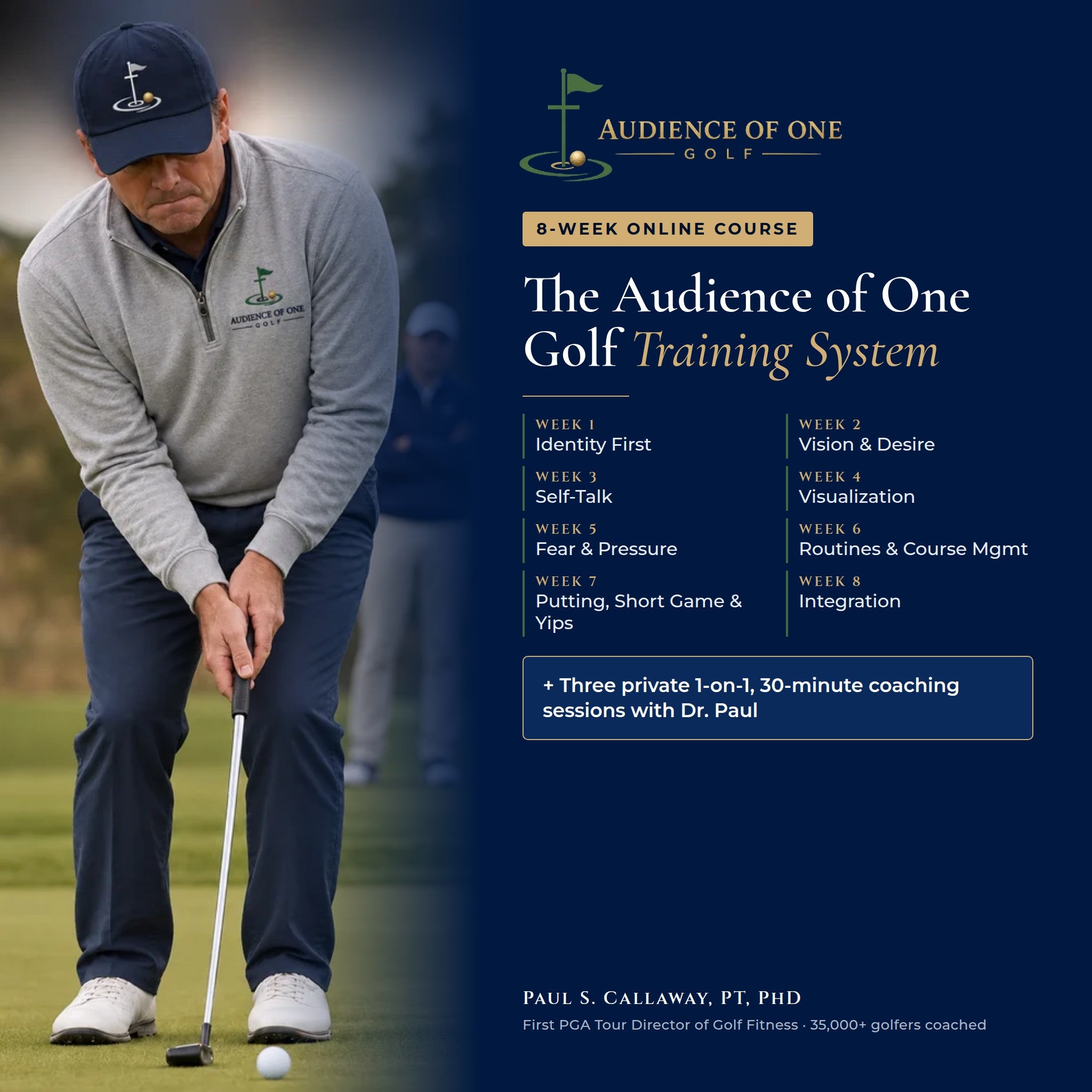
To buy a golf mental training program online, look for a named method, a defined format and timeline, and a way to measure your starting point. The Audience of One Golf Training System is an 8-week online course with a downloadable PDF and three private 30-minute coaching sessions. Start with the free Audience of One Score to see where your golf mental training should focus.
- Look for a named method with repeatable parts, such as the C.O.D.E. Framework.
- The Audience of One Golf Training System is an 8-week online course delivered as a downloadable PDF.
- It includes three private 30-minute remote coaching sessions with Dr. Paul Callaway.
- Take the free Audience of One Score first to get a personal report and 7-day plan.
- Begin with the First-Tee Declaration and One Target, One Thought on your next round.
Table of Contents
- Why Good Golf Stalls on the First Tee
- What to Look for When You Buy a Golf Mental Training Program Online
- How the C.O.D.E. Framework Shapes Your Mental Game
- Golf Mental Training Exercises You Can Start This Week
- Overcoming Golf Performance Anxiety on the Course
- Your Next Step: Take the Audience of One Score or Book a Strategy Session
- Frequently Asked Questions
Why Good Golf Stalls on the First Tee
You've been there. The range session went beautifully. Your drives were long, your irons were crisp, and you felt like the golfer you know you can be. Then you step onto the first tee with a few people watching, and suddenly your hands feel tight, your backswing shortens, and the ball goes right into the trees.
Most golfers assume the problem is their swing. Often it isn't. The hidden cause is an audience problem: under pressure, you start playing for the people watching, the scorecard, or your own fear of looking bad. That shift quietly takes over your decisions.
This is where a golf mental training program can help. A well-designed program gives you a way to think, prepare and reset so that your practice game shows up when it matters. At Audience of One Golf, the program is built around one idea: you play for an Audience of One, and that changes everything about how pressure feels.
What to Look for When You Buy a Golf Mental Training Program Online
Buying golf mental training online can feel like a leap, especially when many options sound similar. The programs that actually help you play better share a few traits, and you can check for them before you spend a penny.
1. A named method, not a pile of tips. A serious program teaches a repeatable system with named parts you can recall on the course. The Audience of One Golf Training System is built on the C.O.D.E. Framework: Christ-Centered Identity, Ordered Mind, Disciplined Preparation, and Enduring Under Pressure.
2. A defined format and timeline. Ask exactly what you receive and over how long. The Audience of One Golf Training System is an 8-week online course delivered as a downloadable PDF, with three private 30-minute remote coaching sessions with Dr. You can see the full course contents and what it includes before you decide.
3. A way to measure your starting point and progress. Before you buy, you want a baseline. The free Audience of One Score gives you a personal report with a 7-day plan. Run it first, then compare what a program offers against the areas your report flags. That turns a vague purchase into a targeted one.
4. Support you can actually reach. Ask how much access to a coach you will really get. Some programs are purely self-guided. Others offer ongoing support. If you want weekly live coaching and a faith-based golf community, you can join the Audience of One Golf Circle and try it free.
5. Content that fits who you are. For Christian golfers, the content matters as much as the method. Audience of One Golf anchors every mental skill to Scripture, using the New Living Translation.
6. A clear way to start. The best program tells you what to do in your first week. Look for a first assignment, a practice routine, and a simple on-course tool.
Watch out: a program that promises a total game overhaul in a weekend usually skips the practice reps that make mental skills stick. Favor a program with a defined number of weeks and specific exercises you can repeat.
If you're not sure which path fits, a free 20-minute strategy session can help you decide. You can book personal mental game coaching, either in person or by video call, and start with that session. Dr. Paul can talk through your options and help you decide which format suits your goals and how much coaching you want.
Before you commit to any program, check it against these six traits. Each one is stated in the article below.
| Trait | What to check | Audience of One example |
|---|---|---|
| Named method | A repeatable system with named parts | C.O.D.E. Framework |
| Format and timeline | Exactly what you receive and for how long | 8-week online course, three 30-minute sessions |
| Starting baseline | A way to measure where you begin | Free Audience of One Score with 7-day plan |
| Reachable support | How much coach access you really get | Online system, Mastery, Circle, in-person coaching |
| Fit with your faith | Content that suits who you are | Scripture-anchored, NLT translation |
| Clear first step | What to do in week one | First-Tee Declaration and One Target, One Thought |
How the C.O.D.E. Framework Shapes Your Mental Game
The C.O.D.E. Framework is the system behind Audience of One Golf. It has four pillars, and each one addresses a different part of the mental game:
- C: Christ-Centered Identity. Your worth is settled before you tee off. You play for an Audience of One.
- O: Ordered Mind. You choose your inner voice and train your thoughts the same way you train your swing.
- D: Disciplined Preparation. You practice with purpose, see the shot before you hit it, and commit to one decision.
- E: Enduring Under Pressure. Pressure is a privilege. You reset quickly, stay steady and finish strong.
Work through the pillars in order. Identity comes first because it protects your mind from the scorecard. Ordered thinking and disciplined preparation give you a repeatable routine. Enduring under pressure is where those skills pay off on the holes that count.
Golf Mental Training Exercises You Can Start This Week
You don't need to wait for a full program to begin. These exercises use tools from the Audience of One Golf system and can be started on your next range session.
1. Use the First-Tee Declaration. Spend 60 seconds before your round reminding yourself whose approval you are playing for. Say it out loud if you can, then take your first swing.
2. Practice One Target, One Thought. Before each shot, pick one specific target and one simple thought. For example: "Hold the finish, eyes on the flag." Keep the thought short enough to hold under pressure.
3. Run the 10-Second Reset. After every shot, take a breath, let go of the last result and prepare for the next. Practice it on the range until it becomes automatic.
4. Score Process Wins. Instead of judging your round by the final number, give yourself 1 point each for a clear target, a full pre-shot routine and a clean reset. Track these points for a week and watch your consistency grow.
5. Rehearse the pre-shot routine. Practice the 10-second routine of Decide, Picture, Breathe, Go on the range until it feels natural. Routines that hold up in practice are the ones that hold up under pressure.
Overcoming Golf Performance Anxiety on the Course
Performance anxiety on the course usually shows up in familiar ways: a tight grip, a rushed takeaway, or a sudden urge to swing harder to "make up" for a poor hole. Your heart rate climbs, your breathing gets shallow, and your attention jumps from the shot in front of you to the people watching. That shift is the hidden cause.

The fix starts before the swing, and it runs in a simple sequence you can repeat on every shot.
Step 1: Catch the thought. When you feel the tension rise, use the Catch, Check, Change method. Catch the anxious thought as it appears. Name it plainly to yourself: "There it is, I'm worried about looking bad." Naming it lowers its grip and moves you from reacting to choosing.
Step 2: Check the source. Check whether the thought is about the shot in front of you or about how others will see you. A thought about the target is useful. A thought about the gallery is noise.
Step 3: Change your focus. Change your focus back to your One Target and One Thought. Pick one specific target and one simple thought, such as "Hold the finish, eyes on the flag." Keep the thought short enough to hold under pressure. Then run your pre-shot routine: Decide, Picture, Breathe, Go. Decide the shot, picture it clearly, take one slow breath, and go.
Step 4: Reset after the shot. Use the 10-Second Reset after every shot, good or bad. Take a breath, let go of the last result, and prepare for the next. Practice it on the range until it becomes automatic, so it is there when your hands start to shake.
Golfers who struggle most with anxiety often find that the pressure eases once they stop trying to eliminate every nerve. The goal is not a calm body on every shot. It's a steady mind that keeps moving forward. As Paul writes in Philippians 4:6-7 (NLT), "Don't worry about anything; instead, pray about everything.
Watch out: if you try to fix your nerves mid-swing, you add tension at the worst moment. Make your Catch, Check, Change and your 10-Second Reset happen between shots, so your swing stays free and your mind stays settled.
Practice this sequence on the range for a week, then take it to the course. With repetition, the reset becomes a habit, and pressure becomes a place where your faith and your game grow together.
Your Next Step: Take the Audience of One Score or Book a Strategy Session
Buying a golf mental training program is a decision worth making carefully. Start small if you need to. Take the free Audience of One Score at https://audienceofonegolf.com/score to see your current mental game profile and get a personal 7-day plan.
If you're ready to talk through your options, book a free 20-minute strategy session at https://go.oncehub.com/PaulCallaway. Dr. Paul can help you explore where your mental game may be holding you back and which path might fit your goals.
Your best golf is already inside you. Play for the Audience of One, and let the pressure become a place where your faith and your game grow together.
Frequently Asked Questions
What should I look for in an online golf mental training program?
Look for a program built specifically for golf rather than general sports psychology, with exercises you can use on the range and during a round. Check that the content covers pressure, focus and identity, and that it gives you a clear structure such as weekly lessons or a set plan. Access to a coach for questions or sessions is a strong plus. Audience of One Golf offers the 8-week Audience of One Golf Training System, which includes three 30-minute private 1-on-1 coaching sessions with Dr. Paul Callaway, so you can judge whether the approach fits your game before committing further.
How does a faith-based approach to golf psychology work?
A faith-based approach anchors each mental skill to a Scripture passage, so your sense of worth stays rooted in Christ rather than your scorecard. In practice, you pair a golf skill such as committing to one target with a verse that reminds you who you play for. The Audience of One Golf system uses this model across its C.O.D.E. Framework. You play with the goal of honoring God in each shot, which many golfers find steadies them when the pressure rises.
What is the C.O.D.E. Framework in golf?
The C.O.D.E. Framework is the four-pillar system at the core of Audience of One Golf. C stands for Christ-Centered Identity, O for Ordered Mind, D for Disciplined Preparation and E for Enduring Under Pressure. Each pillar gives you a practical area to work on, from choosing your inner voice to committing to one decision before you swing. Dr. Paul Callaway draws the framework from the 15 chapters of his book Grace Under Par, so you can study it in depth or start applying it on your next practice round.
How do I know if a golf mental coach is right for me?
Start by naming the problem you want solved, such as tightening up on the first tee or losing focus after a bad hole. Then check whether the coach works with that exact issue and explains how their method applies to your game. Ask whether the first step is low-pressure, which is why the free Audience of One Score and a free 20-minute strategy session are useful places to begin. Both let you see the approach and ask questions before you buy any program.
