

Quick Summary
To recover from bad golf shots, stop the replay before it becomes a chain. Use the 10-Second Reset: breathe and release, speak a short honest truth, pick one target and one thought, then commit and go. Keep your focus on the next shot, not the last one.
- Take one slow breath in through your nose and out through your mouth after a poor shot.
- Use a short honest script of two or three sentences to name the miss and reset.
- Choose one specific target and one simple thought before you walk to your ball.
- Count a Process Win when you caught the negative thought and finished a full routine.
Table of Contents
- That Sinking Feeling After One Bad Shot
- Why One Bad Shot Turns Into Three
- What to Say After a Bad Golf Shot
- Using the 10-Second Reset After Every Poor Shot
- How to Move On From a Bad Golf Shot
- Recovering After a Bad Round of Golf
- Booking Your Next Step Toward Calmer Golf
- Frequently Asked Questions
That Sinking Feeling After One Bad Shot
You step up, make a solid swing, and watch the ball slice into the trees. Your stomach drops. Your shoulders climb toward your ears.
This is the moment that decides a lot of rounds. The shot itself is over in a second. The feeling sticks around for holes.
At Audience of One Golf, we see this moment often. Dr.
The good news is that you can learn to handle this moment. Recovery is a skill, and skills can be trained.
If you want a quick look at how your mental game holds up under pressure, you can take our free Golf Mental Game Screening before your next round.
Why One Bad Shot Turns Into Three
A bad shot rarely stays a single event. It turns into a chain.
The hidden cause is usually not your swing. It is your focus. When your mind stays on the last shot, your body tightens and your attention drifts toward what could go wrong.
Here is the pattern most golfers follow:
- The shot ends badly. You hit the ball somewhere you did not want.
- The mind replays it. You think about how it looked and what it cost.
- The body tenses up. Your grip tightens and your tempo speeds up.
- The next shot suffers. You try to fix the last mistake instead of playing the next one.
The fix starts with one idea from Dr. Paul's C.O.D.E. Framework: your inner voice shapes your performance. Train that voice, and the chain breaks before more bad golf shots pile up.
What to Say After a Bad Golf Shot
The words you say to yourself after a poor shot matter more than most golfers realize. Harsh self-talk keeps the tension alive. Calm, truthful words help you let go.
Scripture gives us a steady anchor for this moment:
"Cast all your anxiety on him because he cares for you." (1 Peter 5:7 NLT)
Try this simple script after a bad shot:
- Name the shot honestly. "That one went right."
- Remind yourself of your identity. "My worth is settled in Christ, not this shot."
- Pick the next target. "Now I play for that flag."
Keep it short. You do not need a speech. Three quick thoughts are enough to move you forward.
Using the 10-Second Reset After Every Poor Shot
The 10-Second Reset is one of the most practical tools in Dr. Paul's system. It gives your mind a clear job during the short walk between shots, and it turns a bad shot into a brief event instead of a long slide. Use it every time a shot goes badly, and use it on the range until it becomes automatic.

Here is the full sequence, second by second:
- Seconds 1-3: Breathe and release. Take one slow breath in through your nose and out through your mouth. Let your shoulders drop and loosen your grip. This is your physical signal that the last shot is over.
- Seconds 4-6: Speak your truth. Use a short, honest script. "That one went right. My worth is settled in Christ. I have a clear target for the next one." Keep it to two or three sentences.
- Seconds 7-8: Pick One Target, One Thought. Choose a specific target, such as the right edge of the fairway or the middle of the green. Then choose one simple thought, such as "smooth tempo" or "commit to the target."
- Seconds 9-10: Commit and go. Take one look at the target, trust your routine, and make the swing. The reset ends when you commit.
That is the whole routine. It fits in the walk from the cart to your ball, and it works for a blocked drive, a chunked wedge, or a three-putt.
Why the timing matters
A reset without timing drifts into rumination. The clock gives your mind a job and a finish line. When you know the reset takes ten seconds, you are less likely to spend the next two minutes replaying the shot.
Practice the reset on the range
Recovery is a skill, so rehearse it. Hit a shot, then deliberately run the 10-Second Reset before the next ball.
Watch out: if you rush the reset and skip the breath, your body stays tight and the next shot inherits the tension.
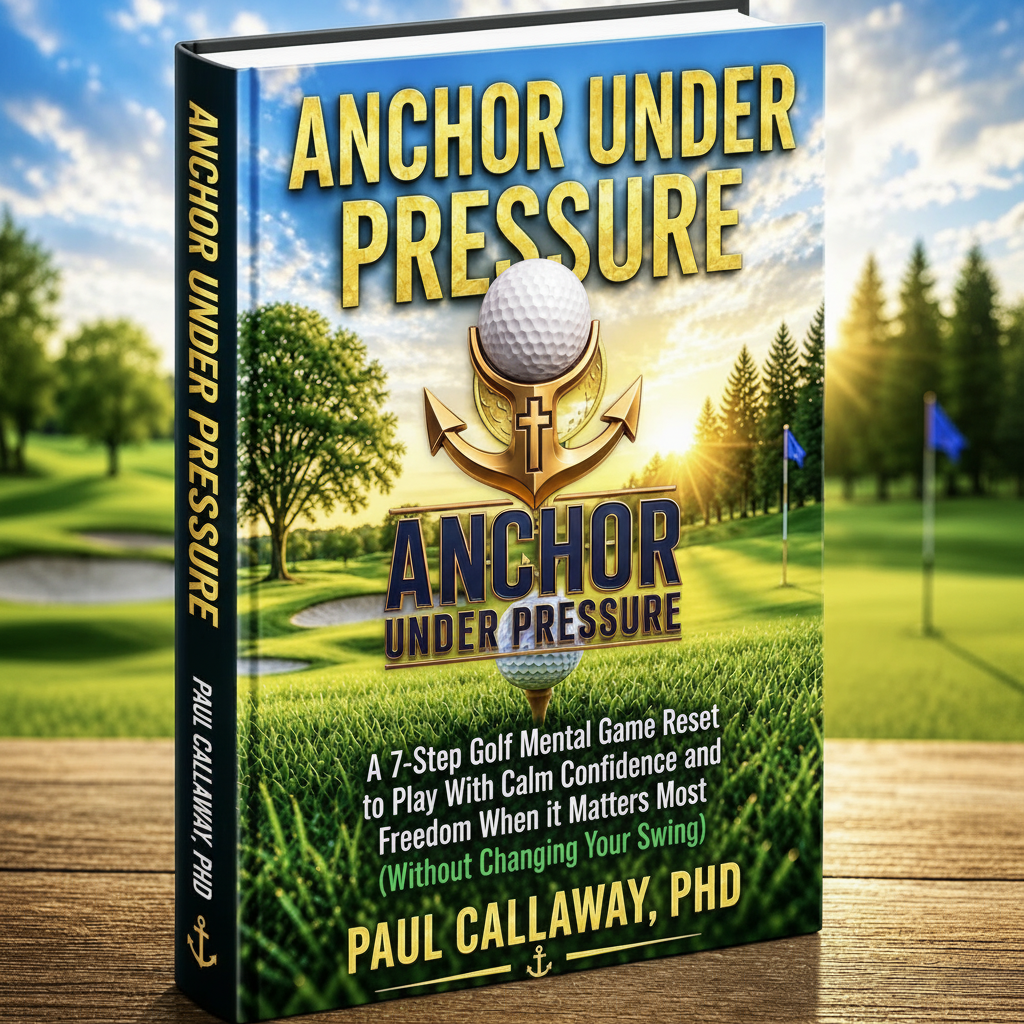
If you want a structured way to practice this under pressure, the Anchor Under Pressure 7-step reset walks you through a complete system without changing your swing.
Here is the full 10-Second Reset at a glance, so you can run it on the course without thinking.
| Seconds | Step | What to do |
|---|---|---|
| 1-3 | Breathe and release | One slow breath in through the nose, out through the mouth; drop shoulders and loosen grip |
| 4-6 | Speak your truth | Use a short, honest script of two or three sentences |
| 7-8 | Pick One Target, One Thought | Choose a specific target and one simple thought |
| 9-10 | Commit and go | Take one look at the target, trust your routine, make the swing |
How to Move On From a Bad Golf Shot
Moving on does not mean forgetting the shot. It means you stop letting the shot decide what happens next. The golfers who recover best are not the ones who feel nothing after a poor shot.
Dr. Paul teaches that your identity does not change with your score. Your worth stays the same whether you shoot 68 or 98. That truth frees you to play the next shot with a clear mind. Here is a practical way to put that freedom into action, shot by shot.
Use Catch, Check, Change in the walk to your ball
Catch, Check, Change is a simple three-step pattern you can run in the time it takes to walk to your ball.
- Catch the thought. Notice what you are saying to yourself. "That was a chunked wedge. I always do that on this hole."
- Check it against the truth. Is that thought accurate, and is it helping the next shot? Replace it with something true and useful. "That was one shot. My routine is solid. I have a clear target for the next one."
- Change your state. Take one slow breath, drop your shoulders, and pick your One Target, One Thought for the next shot.
Run this once, then move on. The goal is a clean handoff from the last shot to the next one, not a long analysis session on the fairway.
Match the recovery decision to the miss
The fix is a simple decision tree for the most common misses. Choose the safe option first, and only take on the hero shot when the lie and the situation clearly support it.
- Blocked drive into the trees. Your first job is to get back to the fairway. Take a mid-iron and punch out to the widest part of the short grass, aiming at a specific tree gap or the 150-yard marker. A 7-iron punched low and running is often the smartest club here. Advance the ball forward and give yourself a full shot to the green.
- Chunked wedge or short approach. The ball is now short of the green, often in thick grass. Take one club more than you think and make a smooth, accelerating swing. Pick a landing spot on the green and commit to it. Your goal is the middle of the green, not the flag.
- Topped shot or thin strike. The ball has run forward but may be in the rough or behind a mound. Check your lie first. From a clean lie, play your normal shot to a conservative target. From a poor lie, take the club that gets the ball back into play with the least risk.
- Bunker miss. If you are still in the bunker, your first goal is out. Take your sand wedge, open the face slightly, and aim at a spot on the green that gives you a putt. If the lip is steep, play out sideways to the fairway and accept the extra shot.
A simple rule of thumb: when you are unsure, choose the shot you can execute with confidence. That is the shot that protects your score and your peace of mind.
Score a Process Win
A Process Win is a way to measure recovery that does not depend on the result.
Over a round, keep a simple tally of Process Wins on your scorecard. That is the heart of the C.O.D.E. Framework: your inner voice and your choices shape your performance.
Scripture reminds us where our hope rests:
"Commit your work to the LORD, and your plans will succeed." (Proverbs 16:3 NLT)
Hand the shot to God, then give your full attention to the next one. If you want a structured way to practice this under pressure, the Anchor Under Pressure 7-step reset walks you through a complete system without changing your swing.
Recovering After a Bad Round of Golf
Sometimes the bad shot is not the problem. The bad round is. Several poor holes pile up, and frustration builds until you stop enjoying the game.
Recovery after a rough round starts with a clear reset before your next session. Take time to look at the round honestly, but focus on the parts you can control: your routine, your targets, and your response after each shot.
Here is a simple approach:
- Review the round by Process Wins, not just score. Count how many shots had a clear target and a full routine.
- Note one thing to practice. Pick a single focus, such as your 10-Second Reset.
- Pray before your next round. Use the First-Tee Declaration to start fresh.
For longer-term help rebuilding your mental game, our 8-week online Training System gives you a structured path with a Scripture anchor for every skill.
Booking Your Next Step Toward Calmer Golf
You do not have to fix your mental game alone.
Start with the free Audience of One Score at https://audienceofonegolf.com/score. It takes about four minutes and gives you a clearer picture of where pressure affects your play.
If you want personal guidance, you can also book a free 20-minute strategy session with Dr. Paul at https://go.oncehub.com/PaulCallaway.
Dr. Paul also offers personal mental game coaching, both in person at Cantigny Golf Academy and by video call.
Frequently Asked Questions
What to say after a bad golf shot?
Keep it short and true. Try a simple line such as 'That one is done, next shot' or 'Good swing, wrong result, reset.' Say it out loud or quietly, then walk to your next shot with One Target, One Thought in mind. Speaking a brief, accurate sentence interrupts the replay loop in your head and gives your attention a new job. Pair the words with a breath, and let the words tell you what to do next, not what went wrong.
How do you mentally recover after a bad golf shot?
Use the 10-Second Reset. Take one breath, release the last shot, pick a clear target for the next one, and commit to a single thought about the swing you want. Then go. Many golfers find that a consistent routine helps the mind settle faster than trying to force positive feelings. Practise the reset on the range so it is automatic when pressure rises on the course.
How can you stop one bad shot from affecting the rest of your round?
Treat each shot as its own event. Scoring is the total of many separate decisions, so the shot you just hit is finished and the next one is new. Use Process Wins to judge the round: a clear target, a full pre-shot routine and a quick reset after each shot. When you score those points, you are playing well regardless of the last result.
How can beginners recover after a bad golf shot?
Choose a safe recovery shot before you step in. If the ball is in trouble, aim for the middle of the fairway or the middle of the green rather than a hero shot. Pick a club you can hit confidently, and make one decision about where the ball will finish. A simple, low-risk plan keeps the hole moving and gives you a success to build on.
